
The Jewel P. Lightfoot Mural
This project was commissioned by the Grand Lodge of Texas in Waco, by Past Grand Master Brad Billings who is currently Grand Secretary. The artwork was conceived over 80 years ago to be part of the backdrop of the main auditorium and believed to have been at the direction of former Attorney General of Texas and Past Grand Master of Texas Freemasonry Jewel P. Lightfoot and is based on a sketch discovered on the architectural model of the building recently discovered in storage. For unknown reasons the project was shelved and I was asked last year to bring it to life in the form of a Triptych. The style is a blend of Egyptian and Art Deco and I brought in gold leaf for the pyramid elements. This was installed this past Saturday in the Grand Secretary’s office. Thanks to Brother Tristan Terrell for his help throughout the project and delivery and Past Grand Master of Texas Brad Billings for his passion to see this come together and making this installation a reality.
I am also including an esoteric interpretation of the artwork.
This is the original concept developed in the 1930s, believed to be under the direction of Past Grand Master of Texas Jewel P. Lightfoot. This is the architectural model of the Grand Lodge building in Waco before it was built, and the Grand East was originally envisioned as having this massive artwork as the backdrop executed as a painted mural. I based all of my line-work and coloring on this model, which is actually tiny, measuring only about 6 to 8 inches across.
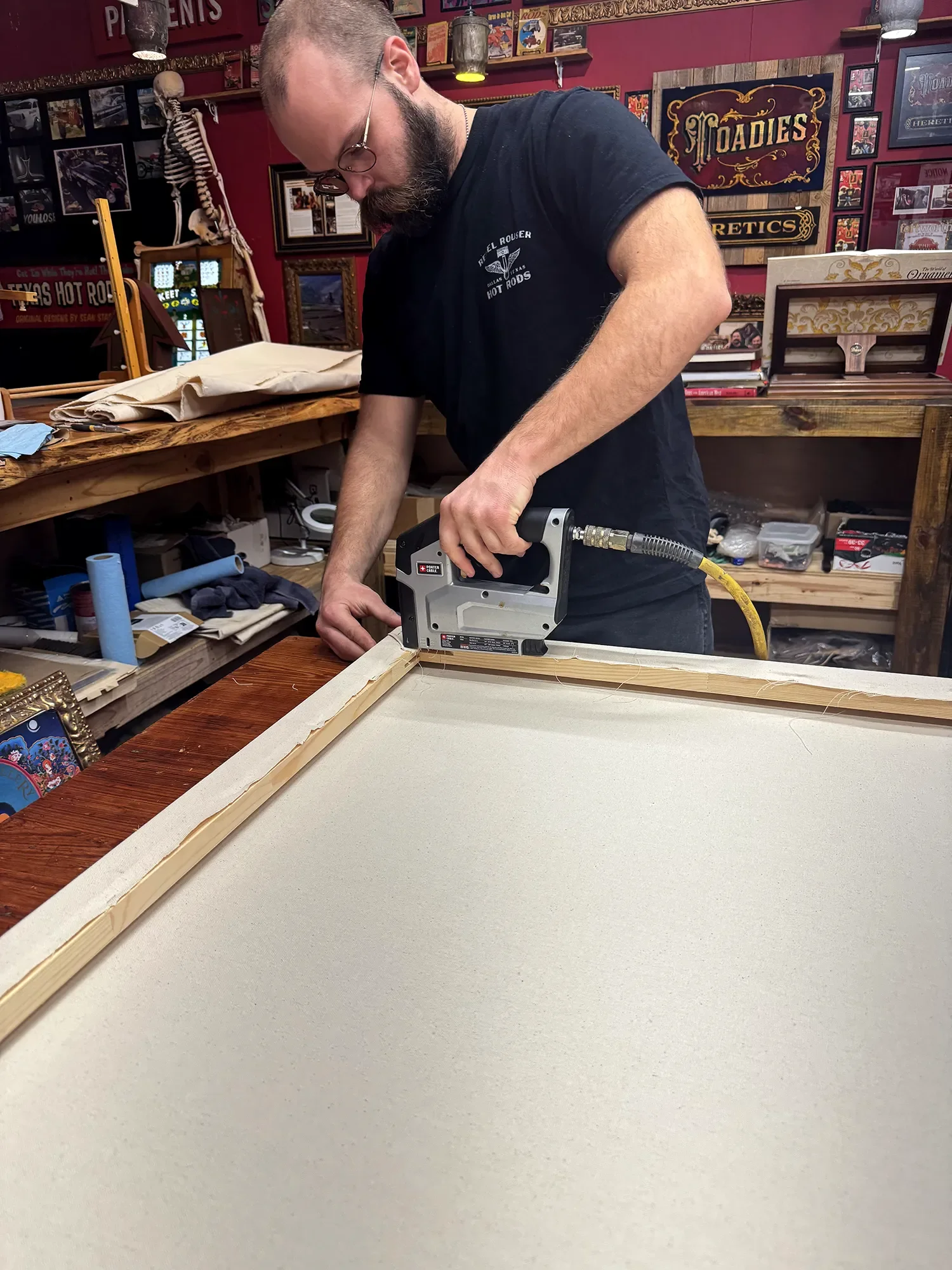
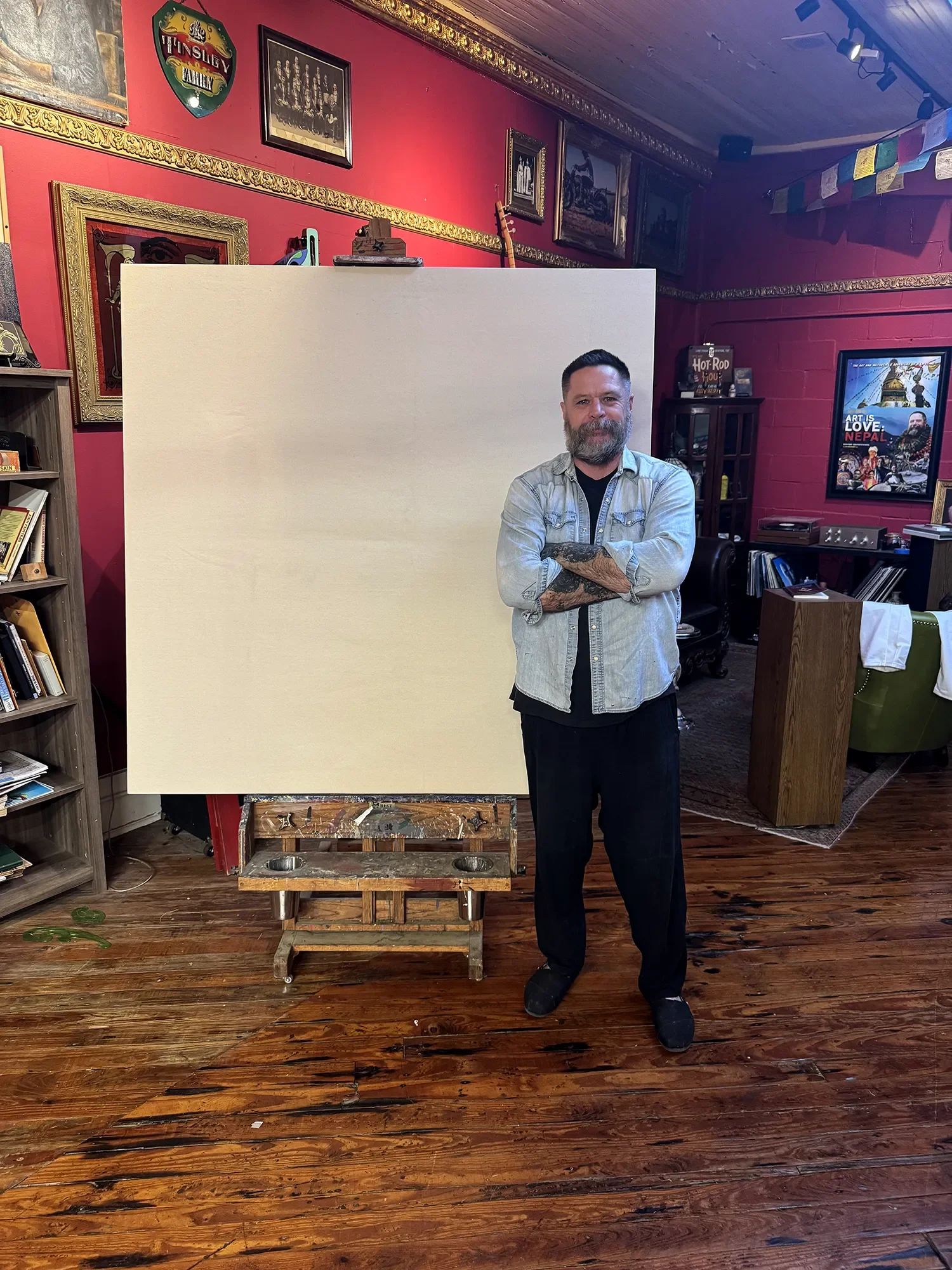
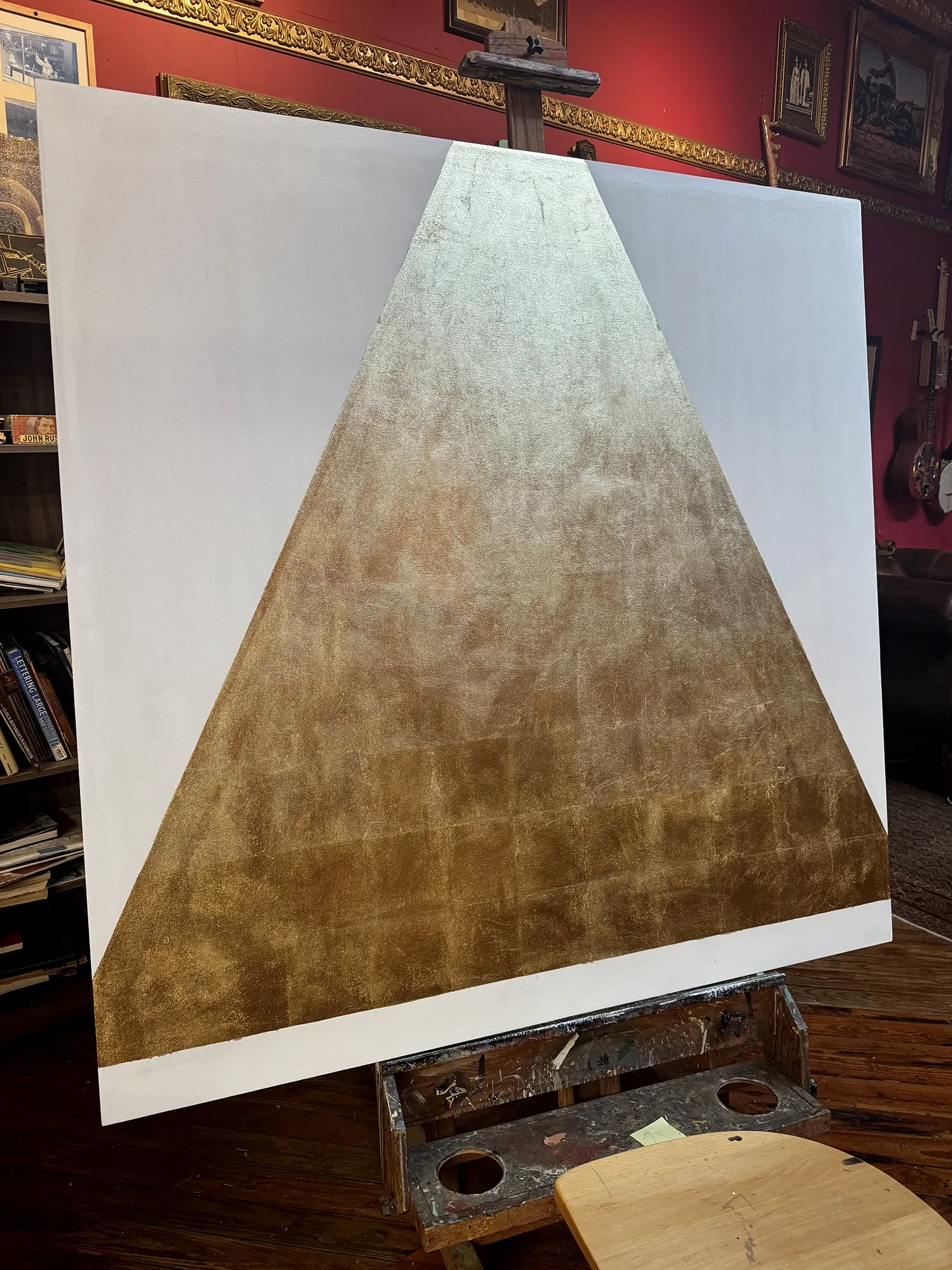
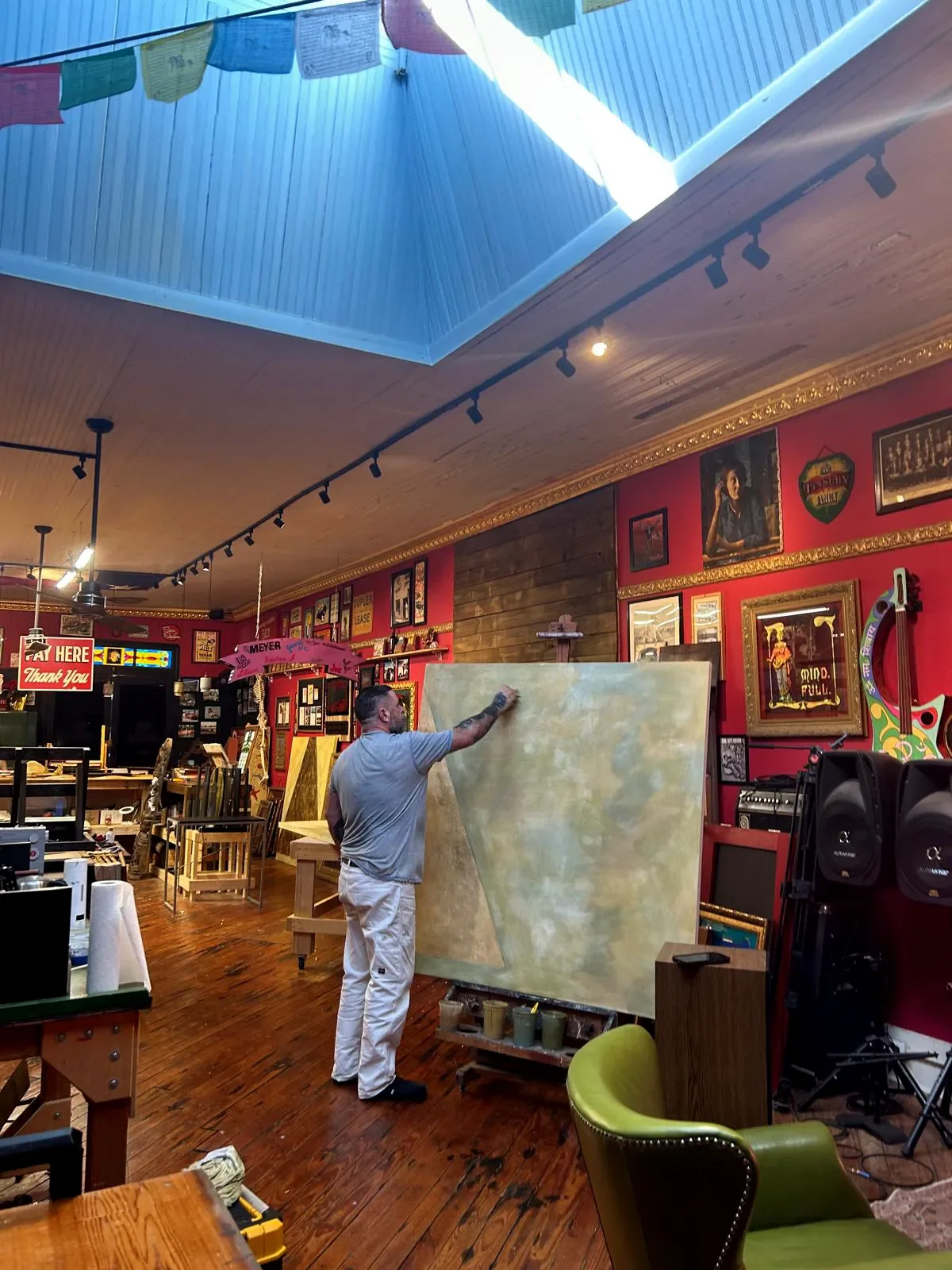
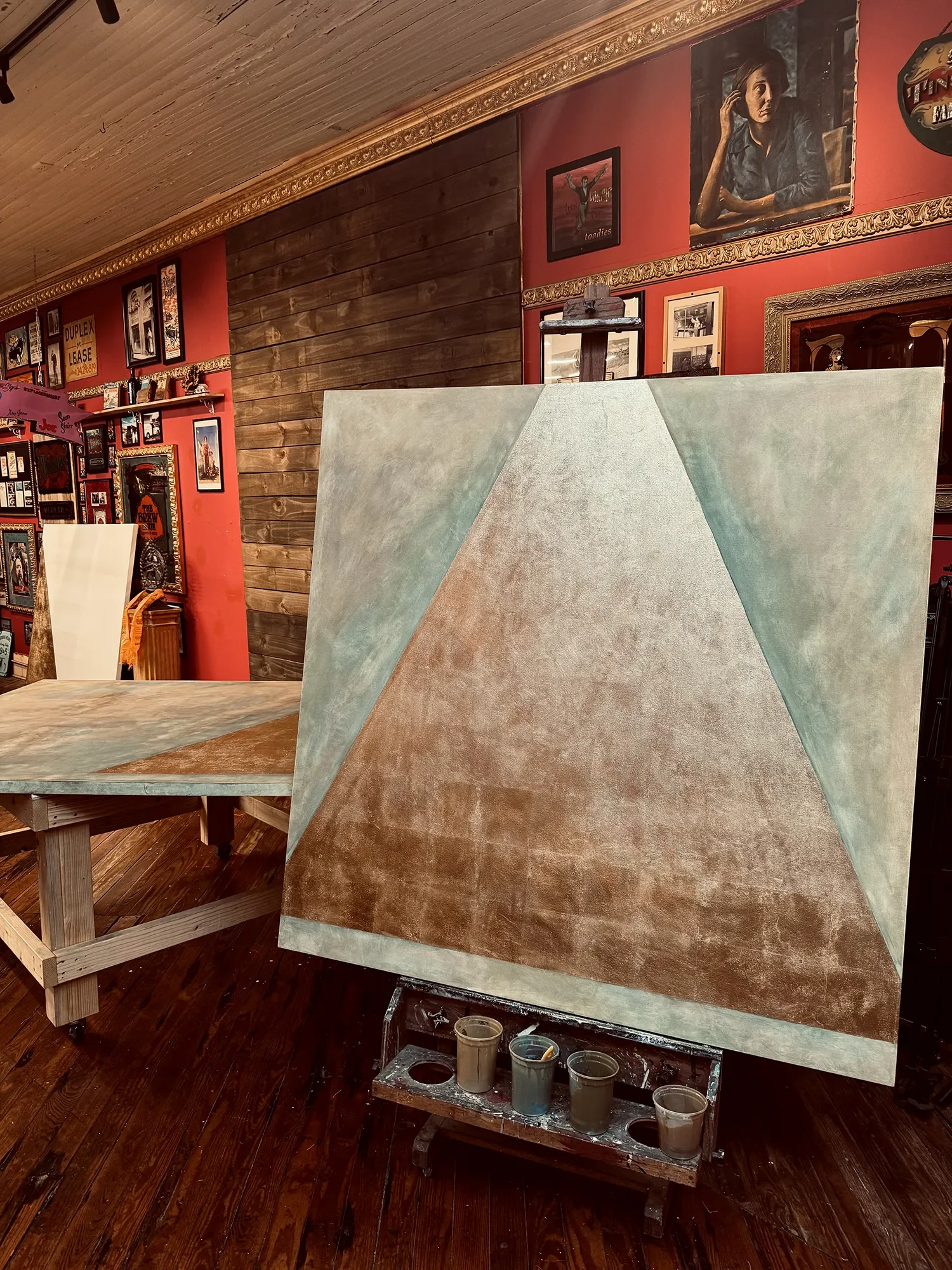
The process started with the stretching of raw cotton canvas onto wooden stretcher bars that measured 60” square. The canvas was then coated with several coats of gesso and then gilded with gold leaf sheets for the pyramid shapes. The background colors required many coats of tinted wash to build up the coloring to match the original feel of the background in the architectural model.
After many months (nearly a year and a half) the final pieces were completed and delivered by truck to the Grand Lodge of Texas in Waco on September 27, 2025. Past Grand Master and current Grand Secretary Brad Billings took delivery of the artwork and the installation in the Grand Secretary’s Office began.
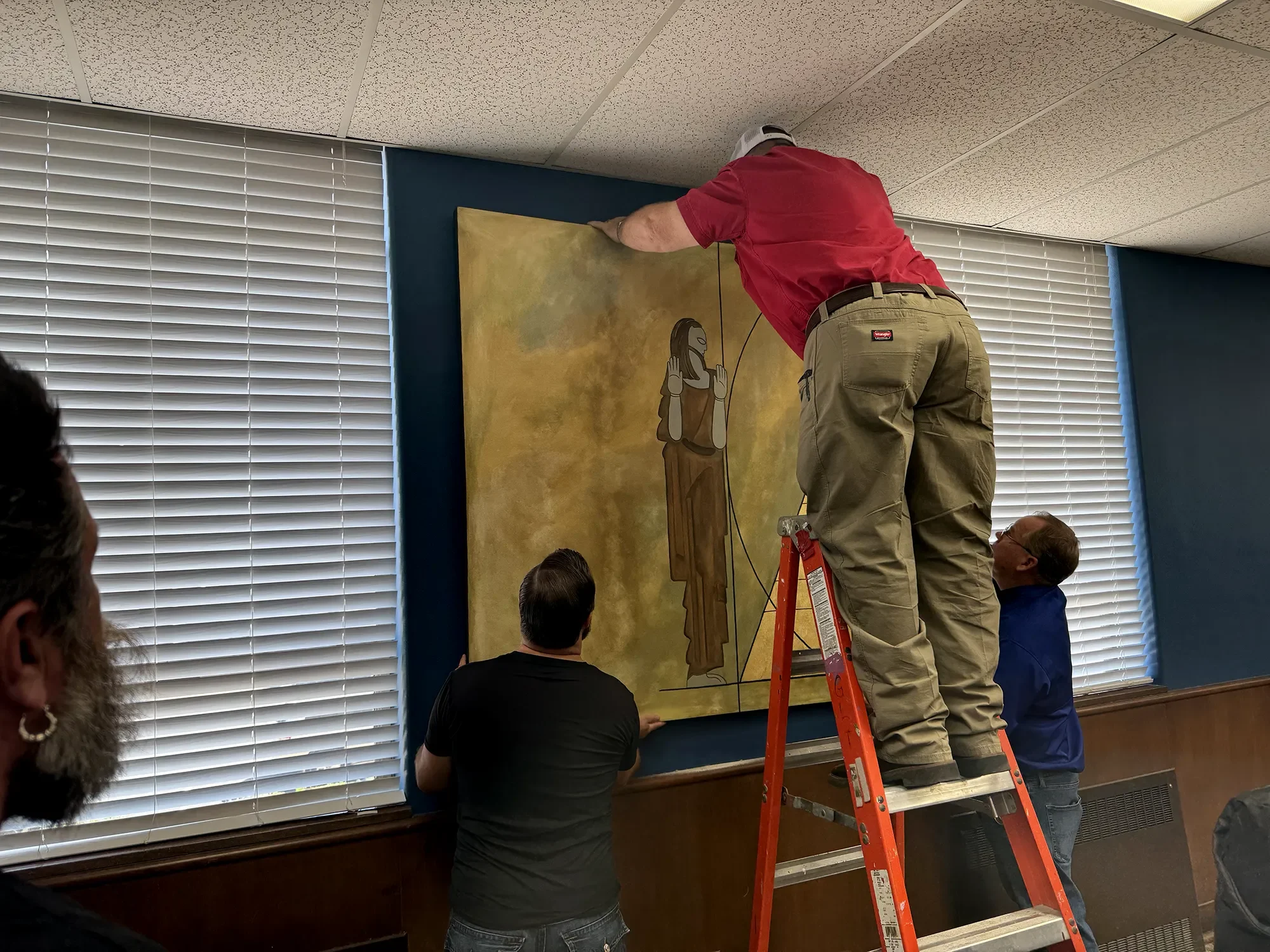
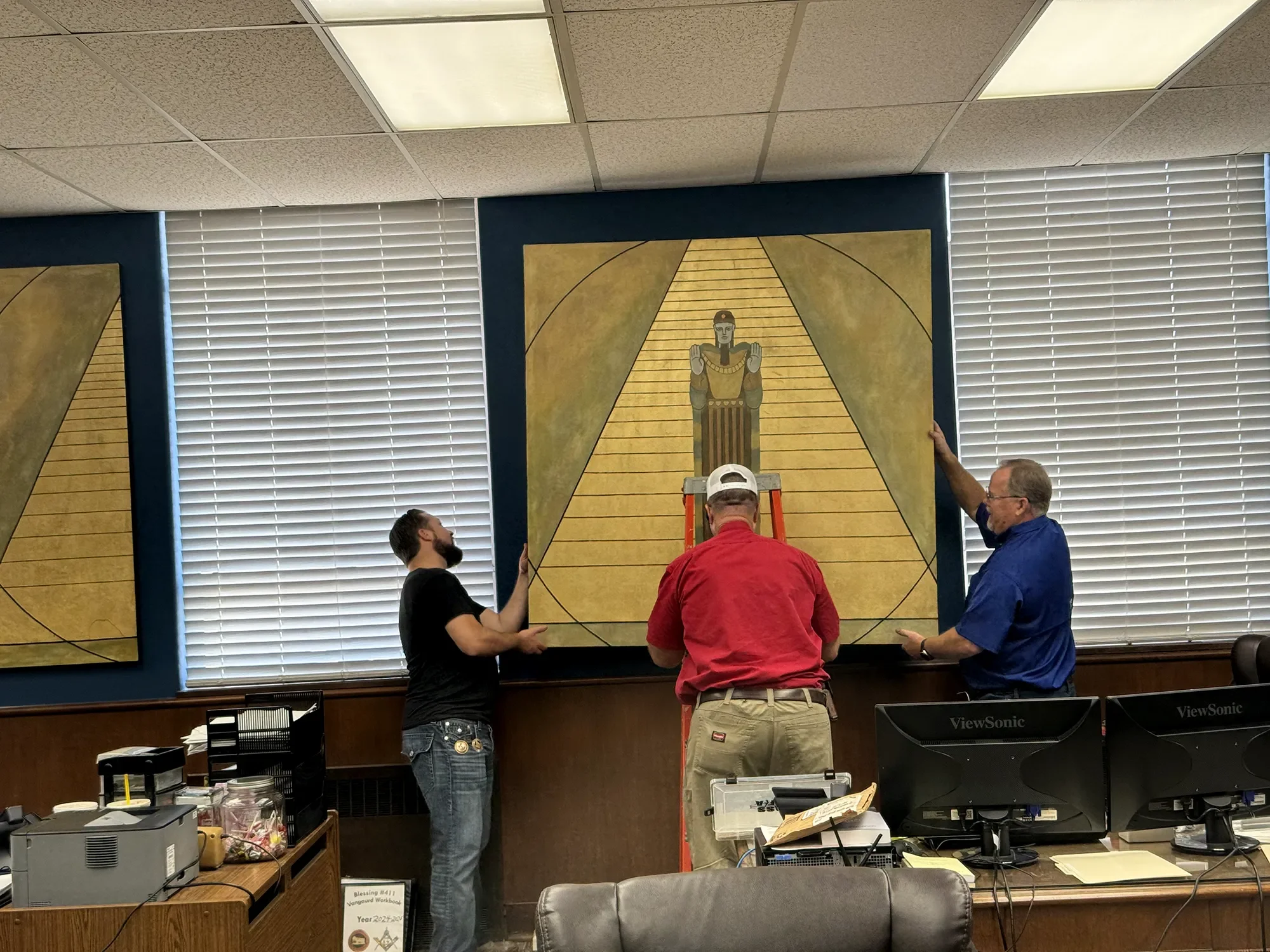
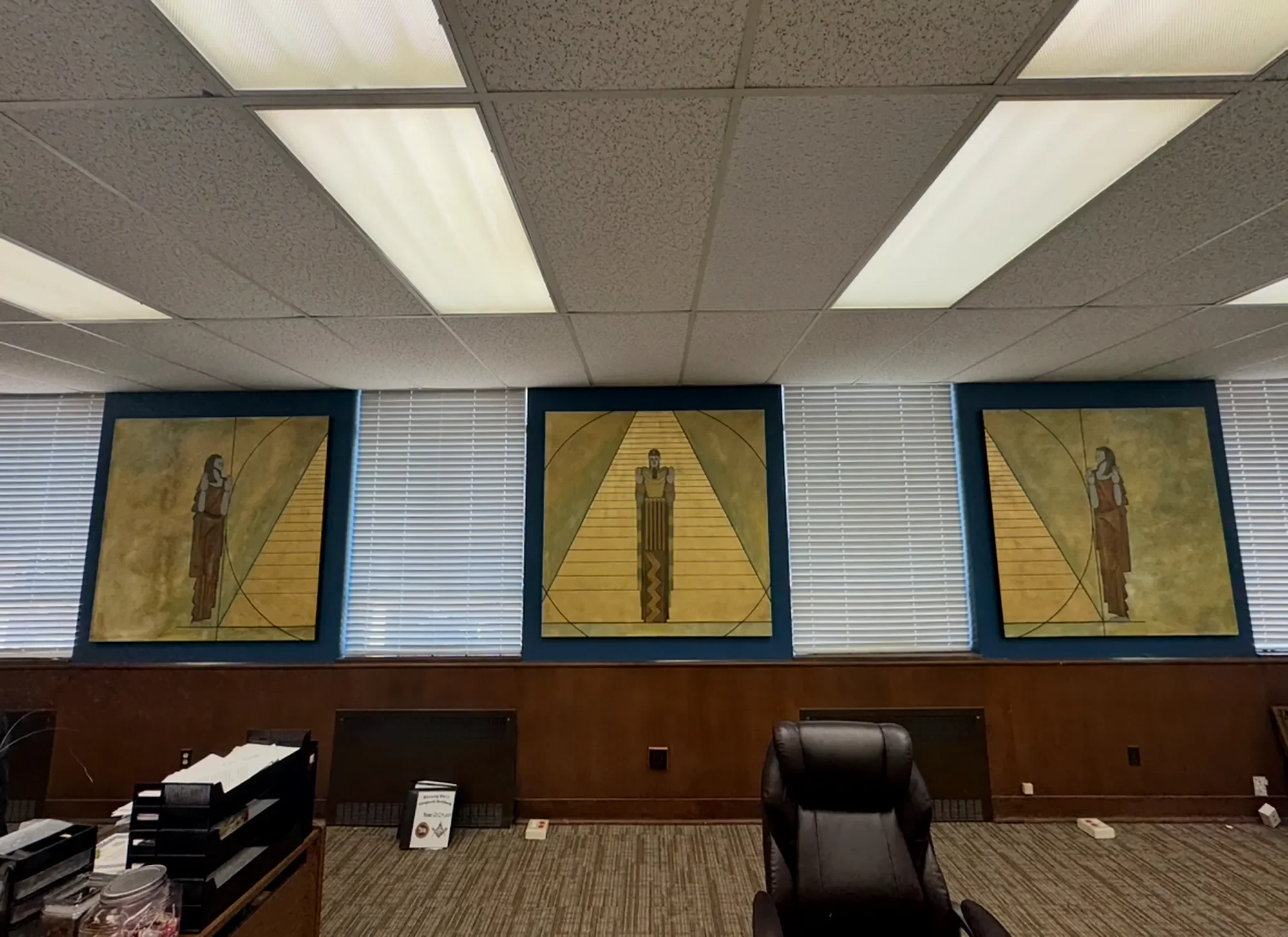
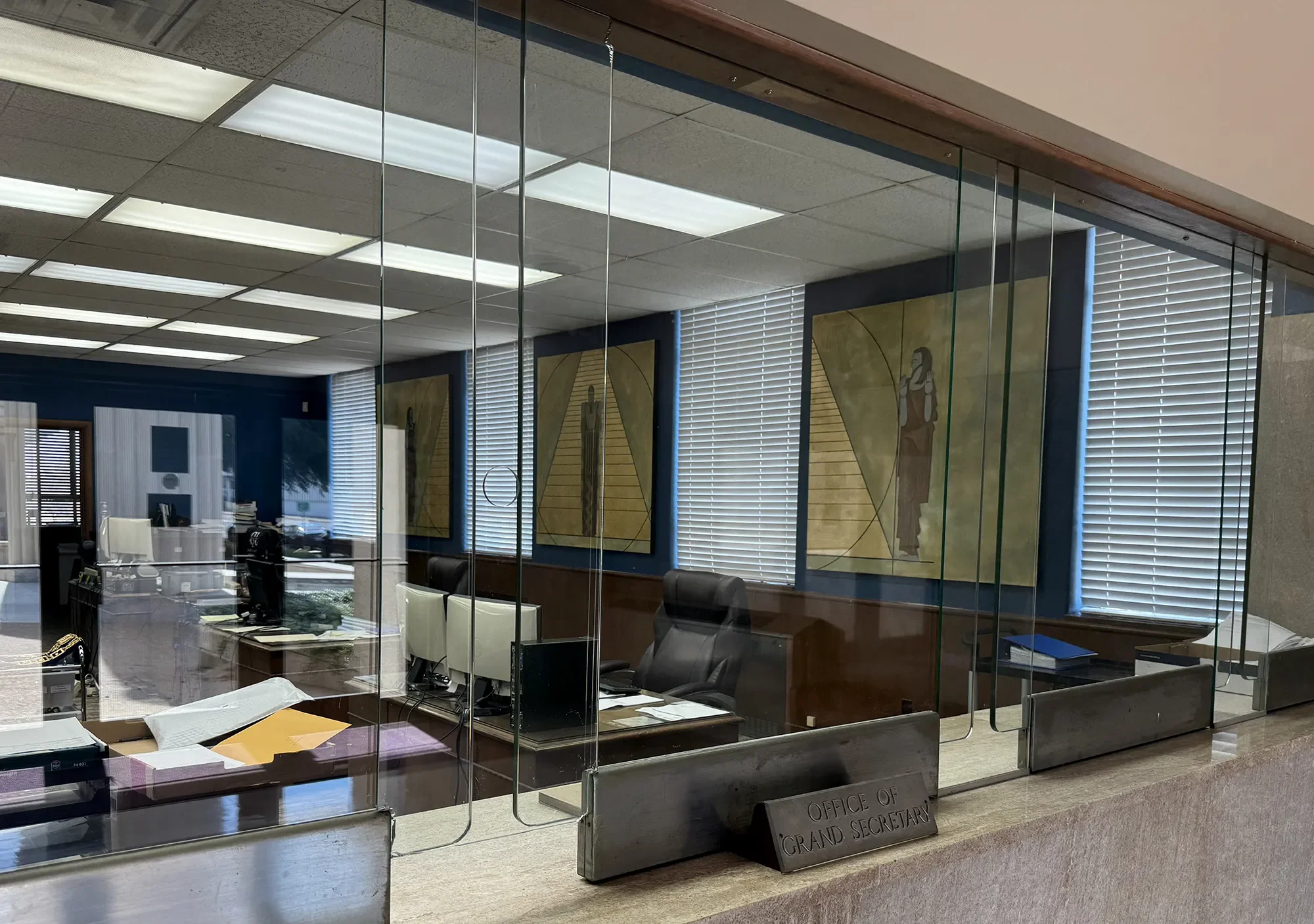
The completed installation of all 3 paintings inside the Grand Secretary’s Office.
Closeup of the completed triptych.
The completed piece digitally edited to form one cohesive image to match the original model, this version was prepared to be used during the Grand Lodge Annual Communication to be projected on the large screen in the main auditorium.
An Interpretation of the Jewel P . Lightfoot Grand Lodge of Texas Mural
By Bro. Sean Starr
At first glance the Grand Lodge mural artwork designed by Jewel P . Lightfoot has some recognizable symbolic elements of Masonry contained within it. On closer examination it would seem that Brother Lightfoot was intending to communicate the Great Work tasked to all Masons, and that of most esoteric initiatic systems through history, that of unity with the divine.
What was Lightfoot trying to tell us with this symbolism?
Let’s get familiar with it piece by piece and then look at its possible interpretation.
The Horizontals
The symbol of the Holy Saints John seems to stand out first visually, but with a peculiar addition: 2 horizontal lines. The bottom line supports the 3 standing figures and there is an additional horizontal line across the middle of the 3, right at the navel. Although clearly referenced visually, the middle horizontal does not appear to be executed completely, but is clearly referenced at the navel of all three characters in the artwork. The focal point remains in the finished triptych.
In esoteric terms, the horizontal axis of life is the plane of existence that is lived in time and space. It defines our sense of space as particular and our experience of time as chronological. The horizontal axis also relates to our relationships with other people and our attunement to meaning and purpose.
The Perpendiculars
The circle is flanked by the familiar 2 perpendicular lines. Verticality implies both Heaven and Earth, a worldview in which meaning and purpose are defined principally by both height and depth, and secondarily by breadth – that is, principally by man’s relationship to God, who is simultaneously ‘above’ and ‘within’ creation, and who there-fore governs all creaturely relationships – rather than by breadth alone –that is, solely in terms of the relationship between the subject and the world.
In alchemy, the Rebis character represents bringing one into a condition of the two opposites in balance.
The “Holy Saints John”
The two saints John, St. John the Baptist and St. John the Evangelist, are patron saints and represent a balanced path to enlightenment: The two saints represent the dualism of passion and knowledge, and are often seen as metaphorical pillars of Freemasonry. St. John the Baptist represents the pillar beneath the earth, while St. John the Evangelist represents the pillar beneath the heavens.
But are these simply the Holy Saints John? Could they be representing something else? Does the pyramid in the artwork point us in a larger interpretation?
The Point Within the Circle
Familiar to all Masons, this symbol also happens to be centered on the central figure’s navel. The point within a circle symbolizes the central, unifying force or "divine spark" within the universe, often representing the concept of God, the Self, or the ultimate source of creation, with the circle signifying the boundaries or limitations of the material world while the point represents the infinite potential within it. It is also the alchemical symbol for gold.
Esoterically, the navel represents the point of connection to the source of life, often symbolizing our connection to our mother, the universe, and our spiritual origin, serving as a reminder that we are not self-contained entities but part of a larger whole; it is also associated with the "navel chakra" in yoga, considered a center of personal power and identity.
The Central Character
Our eye is drawn to the central character of the artwork who is positioned as the axis of all the symbolism contained in the artwork. The Central Character appears to be adorned in finer robes than the two characters on the right and left, and although difficult to see, sports what appears to be an Egyptian styled beard.
The Raised Hands
The unique positioning of the hands stands out and is not commonly seen in Masonic imagery. In esoteric traditions, raising both hands upwards typically signifies a gesture of surrender, receptivity, or connection to a higher power, often representing the act of offering oneself completely and opening up to divine energy; it can also symbolize the balance between the masculine and feminine energies within oneself.
In Hinduism and Buddhism, specific hand gestures called "mudras" carry symbolic meaning, and raising both hands with palms facing upwards can be a mudra associated with surrender or universal connection.
The Golden Pyramid
Descending from above, or possibly similar to a ladder or steps, there is a pathway upward in the form of a golden pyramid. In many esoteric traditions, a pyramid often symbolizes the ascension of consciousness, representing the journey from the material world (the base) to the spiritual realm (the apex), with the sides representing the different levels of understanding or initiation one must pass through to reach enlightenment. Similarly, Jacob's ladder is a symbolic representation of the connection between heaven and earth, and God's plan to reconnect humanity with him.
Interpretation
When the Mason brings his duality into balance, as represented by the two outside characters, and the material plane is brought into harmony with the descending spirit of God, our higher self appears, represented by the central character and ascends to Gnosis and union with the divine.
The Great Work is a symbolic representation of the culmination of the spiritual path, the attainment of enlightenment, and the liberation of the human soul. It is also a process of self-transcendence, where unconscious complexes are brought into conscious awareness and integrated back into the self.
Albert Mackey explains this union as follows:
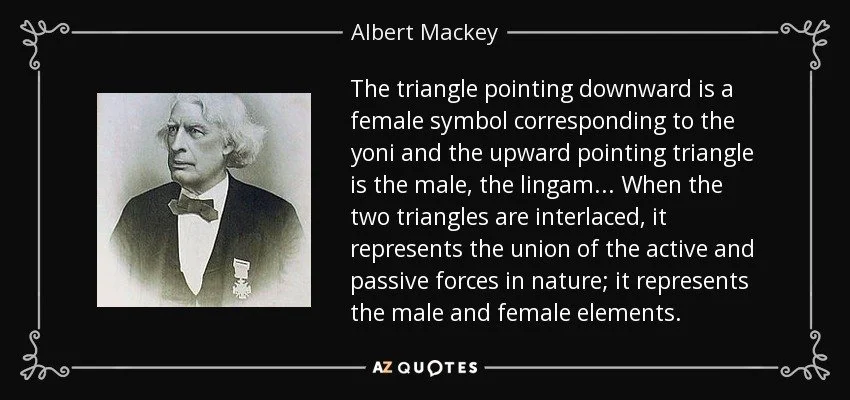
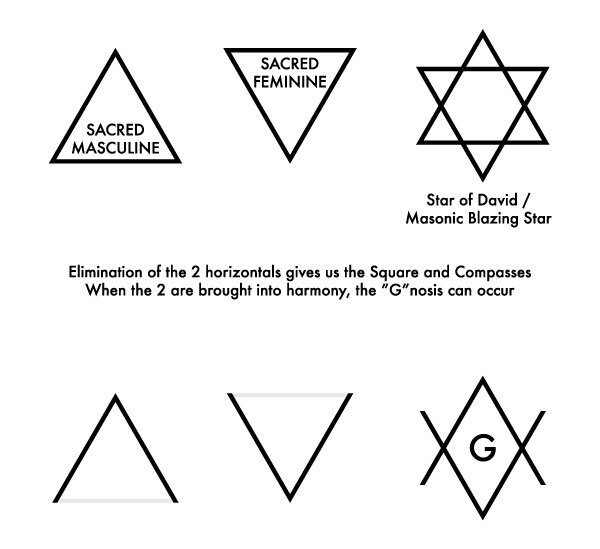
A simplified version of this interpretation can be seen in the equilateral cross of the Templars as well as our most used symbol, the square and compasses.
When the two forces are brought into balance, the Gnosis can occur.
Mackey in "The Symbolism of Freemasonry” explains “Now, this hermaphrodism of the Supreme Divinity was again supposed to be represented by the sun, which was the male generative energy, and by nature, or the universe, which was the female prolific principle. And this union was symbolized in different ways, but principally by the point within a circle, the point indicating the sun, and the circle the universe, invigorated and fertilized by his generative rays. And in some of the Indian cave-temples, this allusion was made more manifest by the inscription of the signs of the zodiac on the circle.”
As with all things in Masonry, there are many layers and many possible interpretations. The message in this artwork is repeated over and over in esoteric traditions all over the world spanning through all of recorded human history.
This is simply my interpretation of what I painted.
